You bring a guy a cracked aluminum boat seat or a busted intercooler pipe, he fires up the same machine he uses on steel, and an hour later you've got a gray, lumpy mess that cracks the first time you load it. That happens more than it should. Aluminum welding in Jacksonville is full of guys who can run a decent bead on mild steel and figure aluminum is the same job with a different metal. It isn't.
Aluminum is its own animal. It needs a different machine setup, a cleaner workspace, and a welder who actually does it every week. Here's why it's harder than steel, what a good weld looks like up close, the kind of jobs that land on our bench, and how to check a welder's aluminum work before you hand over the part.
Why aluminum is harder to weld than steel
Steel is forgiving. It holds heat in one spot, it shows you a color before it melts, and it'll let a so-so welder limp through. Aluminum does none of that.
First, it pulls heat away fast. Aluminum conducts heat about five times quicker than steel, so the puddle you're trying to build keeps trying to spread out and cool off everywhere else. You have to put a lot of heat in fast, then back off before you blow a hole through it. The window is narrow.
Then there's the oxide layer. Every piece of aluminum grows a thin skin of aluminum oxide the second it hits air. That skin melts at around 3,700 degrees. The metal underneath melts at about 1,200. So the surface stays solid while the base turns to liquid under it, and if you don't deal with that skin, it traps dirt and gas right in your weld.
That's where AC TIG comes in. The machine flips polarity back and forth. One half of the cycle blasts that oxide layer off, the other half heats the metal. A steel setup running straight DC can't do that. It's a real reason the same welder who's solid on a steel trailer frame can make a mess of an aluminum one.
Cleanliness is half the job
Aluminum is fussy about contamination in a way steel just isn't. Oil, grease, water, a fingerprint, even the wrong brush will show up in the finished weld as porosity. Those are little gas bubbles trapped in the metal. They look like tiny craters or pinholes, and they're a weak point waiting to leak or crack.
A welder who knows aluminum cleans the part before it ever sees the torch. Solvent wipe, a stainless brush kept only for aluminum, and no touching the joint with a bare hand after. If somebody grabs your part with greasy gloves and goes straight to welding, that's a tell.
This matters even more on stuff that holds fluid or pressure. A fuel tank, a coolant pipe, a hydraulic part. A porous weld there isn't ugly, it's a failure waiting to happen.
What a good aluminum weld actually looks like
You don't need to be a welder to spot good work. You need to know what to look at.
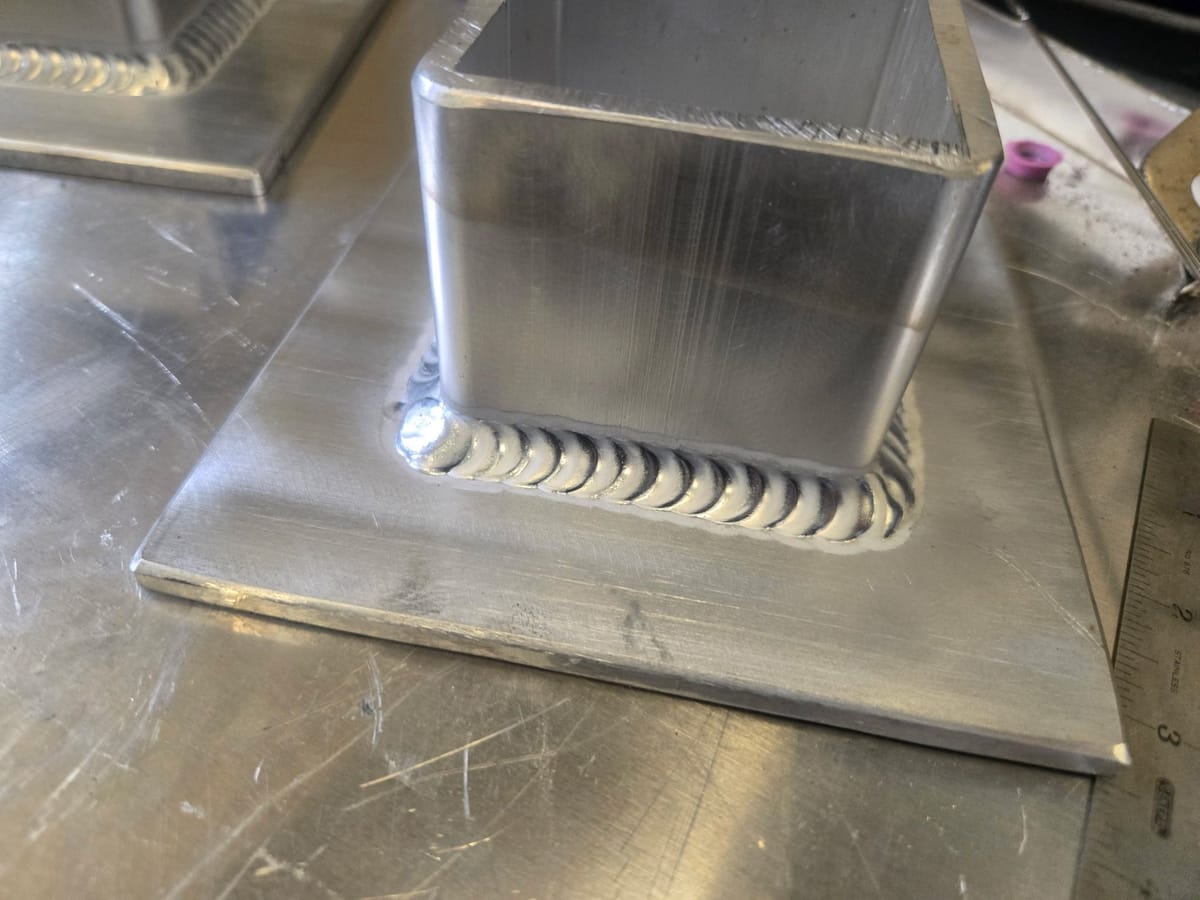
A clean TIG bead on aluminum looks like a row of stacked dimes. Even, overlapping ripples, consistent width the whole length, no fat spots and no skinny spots. That evenness tells you the welder kept steady control of heat and feed the whole way. It's not about looking pretty for the photo. Consistency is the proof the weld is sound underneath.
Run your eye down the bead and look for these:
- Stacked-dime ripples that are even and tight, not random and lumpy
- No porosity. No little pinholes, craters, or black soot spots in or around the weld
- No cracks at the ends of the bead, especially where it starts and stops
- Color that's silver to light straw, not chalky white or heavy gray, which means it ran too hot or dirty
- Good tie-in at the edges, where the weld blends into the base metal instead of sitting on top like a glob
The aluminum jobs we see most
Northeast Florida runs on aluminum. The boats, the trailers, the trucks, the race cars. A lot of it lands on our bench in Jacksonville or we drive the rig out to it.
Marine work is constant. Cracked boat seats and T-tops, leaking aluminum fuel tanks, transom brackets, ladder and rail repairs. Salt and vibration beat that stuff up. We handle marine repair both at the shop on Cahoon Rd and out at the marinas around Saint Augustine and Saint Johns.
On the motorsport side it's intercoolers, charge pipes, catch cans, brackets, and custom valve covers. We do a fair amount of stainless exhaust and header fabrication too, which lives right next to the aluminum work. Then there's the practical stuff. Custom brackets, equipment mounts, fleet repairs, and aerospace parts that need clean, repeatable welds and no shortcuts.
Because we run mobile, a fleet manager in Orange Park doesn't have to pull a truck out of service and haul it across town. We bring the welder to the lot. For smaller parts, people drop them at the shop.
How to vet a welder before you hand off the part
You're trusting somebody with a part that has to hold. A few minutes of checking saves you a redo.
Ask to see photos of their actual aluminum work, not steel. The two look different up close, and a welder who specializes will have aluminum shots ready. Look for those stacked-dime beads.
Ask what machine and setup they use. If aluminum comes up and they don't mention AC or TIG, keep looking. Ask how they clean and prep aluminum before welding. A real answer means they live in this work.
Then check the reviews and the track record. We hold a 4.9 from 26 reviews on Google, and most of that is repeat boat and shop work, the kind of stuff that comes back if the welds don't hold. A welder who does aluminum every week across Jacksonville, Orange Park, Saint Johns, and Saint Augustine has a different feel for it than a generalist who does one aluminum job a month.
Common questions
- Can you weld aluminum with a regular MIG welder?
- You can run a MIG spool gun on thicker aluminum, but TIG gives you more control, cleaner beads, and better results on thin or critical parts like tanks and pipes. For most quality aluminum work, AC TIG is the right call. A standard steel MIG setup won't do it well.
- Why does my aluminum weld keep cracking?
- Usually one of three things. The wrong filler alloy for the base metal, too much heat, or contamination that left porosity in the bead. Cracks at the start and stop of a weld are common when heat control is off. A specialist matches the filler and controls the heat to stop it.
- How much does aluminum welding cost in Jacksonville?
- It depends on the part, the alloy, the prep involved, and whether it's a shop drop-off or a mobile call. Aluminum takes more prep and setup than steel, so it's priced by the job. Call or text (904) 509-1802 with the details and we'll give you a straight answer.
- Do you come to me or do I bring the part to you?
- Both. We run a mobile welding rig across Jacksonville, Orange Park, Saint Johns, and Saint Augustine, roughly a 75 mile radius. For smaller parts you can drop them at the shop at 1089 Cahoon Rd S in Jacksonville.
- What aluminum can't be welded or repaired?
- Most aluminum we see can be repaired, but some castings and certain alloys are tricky and can crack no matter what. The honest move is to look at the part first. Send a photo or bring it by and we'll tell you straight whether it's worth fixing.
If you've got an aluminum part that has to hold, get a welder who does this every week, not once in a while. Call us at (904) 509-1802 and tell us what you're working on. See our aluminum TIG welding service in Jacksonville.